Saturday, January 11, 2014

Unusual Honesty From Editorial


I can't quite believe that actually made it onto the back cover, that's up there with that volume of Blade of the Immortal that actually said "several major story lines [are] finally beginning to dovetail[...] is Samura's epic study on revenge and survival beginning to wind its way toward a massive, final confrontation?"

They are right, though.  The first volume of Knights of Sidonia very much reads like Tsutomu "Blame!, Biomega" Nihei thinking "Hmm, what do normal people like to read? I'll try that," but his attempts to add light comedy to his usual hyperviolence are still surreally awkward and weird because it's still written in his completely affectless style and filled with grotesquerie.  It's honestly not all that far off from that Blame! High School gag he did where all the gnarled silicon monsters were wearing sailor suits and giving each other love letters.

"Teenage mecha pilots vs giant monsters" is a pretty well-worn premise (though I actually can't think of too many manga, it's usually anime), so much so that I won't even go into the plot, but again, since this is a Nihei book, this first volume doesn't really establish anything so much as just hint at it.  Our main character is an alleged regular human in a world full of genetically advanced superpeople, who still seems to have the insanely high pain threshold and healing speed of all Nihei heroes (that Wolverine story really was the perfect choice for him, wasn't it?  Too bad it ended up so dull), which is excellent because even before he gets inside the giant robot he is surrounded with constant threats to life and limb.  His constant culture shock reminded me of The Forever War, though Nihei's trademark understatement means it doesn't amount to more than the occasional sweatdrop as all the mean posthumans in pilot school make fun of him for still needing to eat and excrete regularly, and he accidentally wanders into the girls' locker roomphotosynthesis chamber and gets slapped... not a cartoon comedy Love Hina slap, there are like three panels of his head striking the wall and blacking out, leaving a huge bloodstain and breaking his nose for the rest of the chapter. And eventually they fight a giant fleshy space monster that assimilates one of his classmates as everyone watches in impotent horror. Then after he passes out and vomits at her funeral it's time for a festival and pool party!


It's really hard to decide what to make of this book, largely because the goofy school antics are depicted in the same abrupt and tonally detached manner as the shocking violence they're constantly juxtaposed against.  Knights of Sidonia may be more approachable than Nihei's normal inscrutable action epics, but it's still pretty far afield from normal, it has that same outsider art quality as Mysterious Girlfriend X. I wouldn't call it conventionally "good" but I did enjoy its weird, hilarious awkwardness in the same way I do a David Lynch movie.  I feel compelled to continue.


Saturday, January 4, 2014

Living in Yukitopia

Happy New Year, all.

Lot of exciting Yukito Kishiro news lately; the US release of Battle Angel Alita: Last Order finally finished its interminable, volumes-long Zenith Of Things martial arts tournament, the series is ending this month, and a sequel/spin-off has already been announced.

I kind of gave up on Last Order about, mm, six volumes ago.  The never-ending plot-halting ZOTT was so disappointing that it was making me wonder if the original series was really as good as I remembered, and this seems like the perfect time to scare up my old copies and check the whole thing out from the beginning. As it turns out, it's been just long enough that I'd forgotten most of the specifics, but I still recognize a lot of the little things that pay off later in the series.

And thankfully, it is really damn good, right from the very start.


Kishiro and his publisher had a falling out and the original nine volumes of Battle Angel Alita series are out of print (which is a shame, because Last Order probably makes even less sense without this context), so I'll go ahead and summarize a bit, with a little assist from Kishiro, Fred Burke & co. The series takes place in a future cyborg dystopia:


Back alley cyberdoctor Ido, digging through the trash for spare parts, finds a woman's limbless torso-- still alive, but amnesiac. Rebuilt and renamed, Alita discovers she has the "muscle memory" of a master martial artist and a conscience that can't ignore the cruelties of her new home, which leads her on a high-tech kung-fu hero's journey. In this particular volume, Alita explores her talent for violence, tries to provide a good example for her fellow citizens, and ends up in the sewer fighting a brain-addicted body-jumping severed head.

It's interesting just how quickly this series finds its voice; I know this wasn't Kishiro's first series, but it's still amazing how the series is pretty much fully formed right from the start.  The insanely intricate mechanical detail, the absurdity and gore (he sure loves drawing exposed brains, I count at least three in this volume, more if we allow CAT scans and not just actual exposed gray matter), the wild-ass character designs, they're all here. Check out the mecha-Celtic barbarian with a rampant steel boar-crotch.


Mind, the reason I remember this series so fondly is the strongly drawn characters.  BAA is unmistakably a fight manga, but one always driven by relationships and philosophy.  Alita's relationship with Doc Ido is particularly nuanced by manga standards; he's a generally nurturing figure, but definitely no saint, and his control-freak tendencies give their relationship an interesting Oedipal vibe right from the start.

On the other hand, the philosophy is pretty existential, sometimes even bleak (which is not surprising given the dystopian setting).  There is so much self-actualization through battle that this is practically a sports manga, it's probably the most macho story I've ever seen with a female protagonist. On the one hand, the series is clear that compassion is the difference between a hero and a monster, but it's equally clear about showing the weak being consistently at the mercy of the strong.  There is such an explicit will-to-power thing going on that it honestly might have felt outright fascistic with a dude espousing it. I'm reminded of Jodorowski's Metabarons, which is surprisingly similar to BAA in a lot of ways (including the relentless surreal craziness), but almost none of its (male) leads are at all sympathetic.

Now that I think about it, almost every villain in Battle Angel is male, certainly all the significant ones... actually, Alita herself is often the only woman around at all.  I'm gonna have to come back to this thought when Figure Four shows up (he's super macho, but still an underdog, moreso than any of the other fighters-- he is ass-kicking Krillin), and again with Sechs in Last Order. 

On the other hand, the male-vs-female dynamic works well visually, it adds a lot of contrast to have the pretty small character against the huge ugly ones.  Kishiro definitely loves the David and Goliath thing, to the point where it kind of takes over Last Order.  Even this early, a lot of these fights are right out of Shadow of the Colossus, Alita climbs all over Makaku like a jungle gym.  Like, his head is larger than her entire body, and he just walks around with a severed arm sticking out of his eye socket after she tries to blind him.

Also, because I am insane, I'm comparing the original larger flopped release to the newer (but also tragically out of print) unflopped tankobon-size rerelease.  So far the changes are trivial; dialogue is the same (which also means some of it still refers to the flopped-art orientation of things, whoops) but fonts and occasionally word balloon placement differs, and the new version has a handful of sketches and one or two gag strips in the back.  The unflopped does have nicer paper and print quality, though; the opening sequence, presumably in color in the original, is a much muddier BW conversion in the unflopped.  The color balance is also different in general; the flopped lightens many scenes and elements within scenes, maybe to make the linework pop more, but it does lead to a few panels looking a little washed out. Unfortunately, the smaller trim size of the unflopped edition isn't compensated for, and sound effects very often bleed right off the page or get lost in the book's spine.  On balance, the flopped version is superior, but good luck not paying an arm and a leg for it.  The flopped edition also includes the first chapter of the second unflopped volume, which both puts the complete Makaku arc in one volume, and makes sure a certain important character debuts in the first...

Overall, Battle Angel is a really engrossing mix of high and low, mingled constantly-- we go directly from high-speed cyborg fighting to verbal philosophical sparring to a crotch-mounted cybernetic scanner in the shape of a giant boar's head. It tickles both the base and low impulses.  It just all seems so primal.  And of course, it's also really nicely drawn, and Kishiro only gets more polished as the series goes on.  I'm really glad this first volume lived up to my fond memories of it, considering how badly wrong Last Order went, but who knows? Maybe I'll have a new appreciation for it by the time I get there in this reread.

Wednesday, January 4, 2012

The Hidden King

So I've been reading Nabari no Ou lately, and it's actually better than I expected. On a plot level it's not terribly ambitious (a sulky, androgynous teenage ninja goes on a magical McGuffin hunt), but it's got a few things going on under the surface that catch my eye.

The big one is that this is one of the surprisingly few ninja manga I've read that remembers that ninja are spies and liars. Every single character has ulterior motives (not all of which the reader is privy to), loyalties are often divided, and at least one triple-cross has been sighted. We haven't reached Death Note levels of plots-within-plots (at least not yet), but the constant simmering undercurrent of "I know you're lying to me, but I'll pretend to ignore it because I'm lying to you too" livens up things tremendously. I also enjoy how the "ninja villages" are metaphorical, updated with modern facades (I was amused that one poses as a temp agency). People still use swords and throwing stars a lot, but they also know what guns are.


I also like that these are Ninja Scroll/Basilisk style ninja whose cool esoteric techniques come with awkward drawbacks. As of volume 7 the number of total freaky mutants is pretty low (and even they're more sleek killing machines than misshapen monsters; this does run in the same magazine as Black Butler), but advanced ninjutsu either has morally questionable requirements or messes up the user pretty bad, as in "one of the main characters is quickly going blind and deaf".

Another pleasant surprise is that the women in this series have lots to do. Again, this runs in G-Fantasy, so the hero may well not have any interest in women, which frees them up to actually be supporting cast and participate in the plot instead of just motivating the hero by getting kidnapped or being part of his harem. Quite a few of the villains and walk-on characters from other ninja clans are women too. This pleasantly reminded me of Fullmetal Alchemist (both series also share a habit of randomly breaking the mood with cheap jokes), and I was not too surprised to find out that Kamatani is a woman.

On the other hand, I don't think this series actually passes the Bechdel test, because all the notable female characters I can think of are either trying to help or manipulate the main (male) character (discussing his mysterious powers still counts as talking about him, I think), or are motivated by their devotion to or hate for a man, and there's not really a lot of non-plot-related chit-chat.

I don't want to oversell this series too much; Nabari no Ou is still fundamentally a Teenagers Against Evil manga, with all the tropes and baggage you'd expect if you've ever read one of those, but I'm definitely enjoying it a lot more than I expected to. It takes a couple volumes to warm up, but once it turned that corner I started seeing some promise, and I'm willing to stick around and see how things develop.

One more label gone

So it looks like Bandai is doing the Geneon thing.

Lately I've been going through a lot of my old backlog to show friends who never saw this stuff the first time around, and it's been faintly odd to see all the logos for companies who are now long gone. And now one more.

Sunday, January 1, 2012

Akira Kurosawa

Monday, December 26, 2011

Detective Dee and the Out of Context Clues


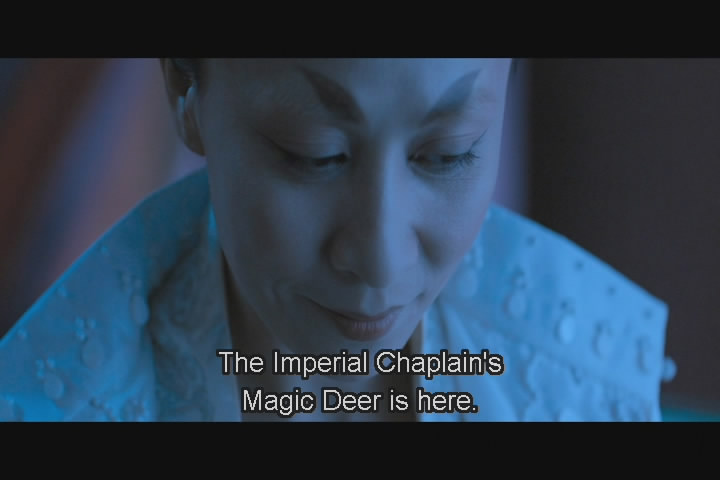
Don't have time to give Detective Dee and the Mystery of the Phantom Flame the review it deserves, but this is well worth seeing, Tsui Hark brings that old wire-fu magic yet again. The translation is good enough that I could follow the plot, but not SO good that I was denied classic HK moments like the above. Perfect.

Thursday, October 13, 2011

Dazzling the stage!

Helldriver is the kind of movie where, while choking her daughter to death, a woman gets a hole blown clean through her chest by a meteor, and then without missing a beat, she rips out her daughter's heart and sticks it in the smoking cavity, where her other organs start healing around it.

As you may have guessed by the fact that I'm bothering to post about it, this is another one by B-movie hero Yoshihiro Nishimura (writing and directing this time), so that happens about ten minutes in, and is pretty much the tip of the iceberg of insane special effects and high-pressure fake blood antics that I'd be screencapping like mad if I hadn't just come back from a festival screening. As usual, conventional reviewing techniques are useless against him, but this is another one deep in the "deliberately ridiculous" zone, and actually relatively restrained in terms of gore effects per se; of course, "restrained" by Nishimura standards means "when zombies get chopped into bits you usually don't see recognizable organs".

The crazy SFX is much more constant than his last two projects; in fact, there's so much craziness going on in this one that it became a bit overwhelming by the end. That's kind of all there is in this one though; the lead character is a leaden cipher (I think she only has like ten lines of dialogue, and nowhere near the screen presence to pull it off), and there isn't so much a plot as a collection of chainsaw fights, zombie dance clubs, Imperial Japan imagery, Verhoevenesque public service announcements, dozens of ways to contextually translate "-chan", and possibly the coldest open I have ever seen. I'm still waiting for another one of these movies to have the same level of overall craft as Tokyo Gore Police (come on, Mutant Girls Squad), but I'd rank Helldriver above the faintly disappointing Robogeisha and Vampire Girl. It hits home video next month, so if this sounds like your brand of cheap thrills, buckle up.

Wednesday, July 27, 2011

King of RPGs Second Edition

King of RPGs volume 2 has fewer references to porno manga than the first, but since its ending seems like a suspiciously good break point if further volumes don't get greenlit, it seems like a good time for a closer look.

KORPG actually has some surprisingly complex structure given how broad the jokes are. I always get a kick out of structural metahumor; Thompson has a longtime interest in both RPGs and manga, and it's amusing how seamlessly he fits the conventions of tournament battle manga (childhood inspirations sparking lifelong obsession, villains almost more interesting than the heroes, each more powerful than the last, defeat means friendship) with the inside-baseball gamer humor of Knights of the Dinner Table, Order of the Stick, Darths & Droids, DM of the Rings, etc (satanic panics, LARPing, adversarial GMing, and some MMO stuff in volume 2). It's especially great when the two synergize, like referencing Death Note to emphasize the Game Master's control-freak nature.

The main idea of "Shonen Jump-style battle manga about Dungeons & Dragons" isn't a very pointed parody given that things like Yu-Gi-Oh and .hack have already played it completely straight, but this time there's the occasional undercurrent of absurd black humor from the tone clash of zany unrealistic plot elements uneasily butting up against the reasonably honest portrayal of the main character's emotional problems. It's either tasteless or ballsy to have the plot basically boil down to "Mazes and Monsters by way of Bastard!", but then Thompson always was fond of manga's transgressiveness, and "Jack Chick was right!" is pretty much the ultimate taboo in RPG circles.

And finally, there are lots of tiny throwaway jokes all over the place, from the blatantly referential to the obscure (like Shesh Maccabee's signature in-game weapon). The art's quite nice too; Victor Hao's got a nice, cartoony expressiveness that works well for the comedy and lends the proper flair to all the scenes and characters.

I'd be happy to see more of this, but frankly the odds seemed kind of against even getting as much as we have. I'm honestly not sure if you can fully appreciate King of RPGs without having spent way too much time both reading manga and playing RPGs (though actually we have a couple guys like that here on the blog), but if you are one of those rare no-life kings, you should definitely check it out.

Tuesday, July 26, 2011

Best news ever

This year being the 25th anniversary of Jojo's Bizarre Adventure and the 30th anniversary of Araki Hiroyuki's career, I was sort of hoping we might finally get a kanzenban I can't afford but would buy anyway.
Instead, we get Jojorion/Jojolion, the eight Jojo series, and a package designed for me personally -- three Jojo's Bizarre Adventure novels.
Written by Kadono Kouhei, Nisioisin, and Maijo fucking Otaro.
http://www.araki-jojo.com/74/
Kadono's, in typically eccentric fashion, apparently features Purple Haze.

Friday, July 8, 2011

Out of Context Theater Presents: Trust The Cybercactus


From Splatter: Naked Blood, which is actually less exploitative and more disturbing than you'd guess from the title. It's very Cronenberg actually, with a very sterile-surreal medical ero-guro vibe going on. It's unsettling in the way I was kind of expecting Lychee Light Club to be. I found it quite harrowing to watch, actually, don't let this benign cactus-voyeur interlude lull you the way it did me. BuyerNetflixer beware on this one.

Tuesday, July 5, 2011

So-so Gothic & Lolita

After watching both Psycho Gothic Lolita and Geisha Assassin, it seems clear that Go Ohara is better at coming up with catchy, trashy titles than he is at directing the movies he puts them on. I'd hoped he'd avoid repeating Geisha Assassin's mistakes, but no such luck. In fact, I think this one may even be a step back.

Like Geisha Assassin before it, this is a revenge movie; our heroine wants payback, and spends just about every minute of screen time pursuing it. It's basically Kill Bill wearing more black lace, but unlike that flick, the tone is all over the place. The movie clearly wants to be goofy (like, there are cartoony zoom noises when severed heads go flying), but none of the gags are actually funny, or even jaw-droppingly tasteless enough to get laughs of disbelief. On the other hand, it also fails at being dramatic; it hits classic beats like the idyllic flashback shattered by violence, and the heroine confronting the monster that chasing revenge has made her, but those scenes are so lackluster that they don't add anything to the film besides putting another mark on the genre checklist. I'm not even going to get into the completely random twist in the final act, beyond saying that the nod to it on the cover makes it look much more central than it is.


Also, the budget is clearly super, super low. Certainly not a hanging offense, but it sure doesn't help either; at least one of the sets is very conspicuously re-dressed, and the splatter effects are pretty unimaginative despite being "supervised" by the mighty Yoshihiro Nishimura. There's a little wire work, but not only is it not very good, it's an integral part of what is hands-down the worst scene in the entire movie, a hellish combo of so-so action, mediocre special effects, and terrible, interminable humor. That scene is pretty much the entire movie's sins in microcosm; it tries to make up for its visual shortcomings with campiness, but it's not actually funny, so it just ends up being doubly painful. I'd actually prefer it if they'd just stayed sincere instead of trying to win audience sympathy with cheap laughs... which is actually what Ohara did in Geisha Assassin.

In the end, Psycho Gothic Lolita is a run of the mill B-movie, uninspired on every level and middlingly executed. There are crumbs of fun here and there (like the gunfighter who constantly talks on her cel during a running gun battle, and the multiethnic team of super acrobat delinquents), but this film is in dire need of a better script, direction, acting, and action scenes. I kind of hate to dump on Ohara, because he is clearly trying to make the kind of dumb-fun movies I like seeing, but I have flat-out been bored by both of his. I gotta recommend everyone avoid this one.

And speaking of cheap shots, I can never resist poking Media Blasters for their omnipresent typos. At least this time it wasn't on one of the menu options.

Monday, June 20, 2011

Light and fruity

I've been a fan of Usamaru Furuya for a long time; or more accurately I've been a big fan of Short Cuts, since until recently only that and maybe five pages of his other surreal gag series Palepoli were all that were available Stateside. But we seem to be coming up on a nice boomlet of his work in translation, so let's check it out.


A casual reader of this blog will notice I'm no opponent of excess for its own sake, but Lychee Light Club's earnest transgression seemed a bit pedestrian. Or maybe I'm just jaded. I'll just crib from the back cover in lieu of summing up the plot, since Vertical sells this better than anyone short of Carl Horn or Stan Lee:

"I AM HUMAN. IT IS IN MY PROGRAMMING."
For the sooty industrial town’s lads there’s only one point of light: the Light Club, a secret brotherhood they’ve organized in an abandoned factory. They’re on the verge of booting up their crowning achievement, a “thinking machine” fueled by lychee fruits. At the same time, the middle schoolers’ cooties-fearing solidarity is devolving into a downright National Socialist muck of murderous paranoia, perverse aestheticism, and (not always) suppressed homosexuality. Cult favorite Usamaru Furuya’s most flawlessly realized work to date, here is Lord of the Flies for our new century— a text, however, that will never be assigned in schools.


This is an adaptation of a stage play, and it definitely bears the signs of it, particularly the extreme parsimony of characters and location; the Light Club themselves are pretty much the only characters with speaking roles (and most of them get like five lines at best) and almost all the action takes place in the basement of their clubhouse. This does work pretty well for evoking a seething inbred hothouse of festering emotion, but on the other hand, the delicately cruel bishounen aesthetic of the character designs tends to make their ranting come off as overly mannered, whereas I'd imagine an actual actor performing the lines would give them some appropriately manic delivery.

There are occasionally moments of gonzo, and some genuinely wince-inducing moments (man, poor Tamako), but overall I kind of feel Lychee Light Club didn't provide much I couldn't have imagined just from reading the back cover. This is a strange thing to say about a story that involves a fruit-powered robot kidnapper, but I was expecting Furuya to bring more originality and genuine surreality to the basic Clockwork Orange/Lord of the Flies youth-gone-wild setup. Well, OK, he does add explicit gay sex, but that's not too unusual in a manga context (or if you know anything about Yukio Mishima). Actually, that's the problem in a nutshell; I can see this story being audacious and disturbing in live-action (Organ is uncomfortably coming to mind, and actually now that I think of it, Kei Fujiwara worked with the Tokyo Grand Guignol, didn't she?), but as a manga it invites comparison to some of the world's most infamously upsetting and nauseating imagery, and Furuya just didn't step up his game enough to compete. Better luck next time.

Wednesday, May 11, 2011

Media Diary: Utena Interlude

Here's some more stuff I did instead of screencapping Utena.


Star Driver has some of Utena's campy charm, but inherited almost none of its strengths and actually managed to worsen its flaws. Takuto is an even more one-dimensional and boringly invincible protagonist than Utena: once you get used to the Zero Time set design the fights stop being interesting to look at, and his constant victories feel completely unearned. Forget physical danger, he's never even in emotional jeopardy. The supporting cast can't pick up his slack either, there are so many characters fighting for screen time that people vanish for long stretches of the show, or get written out entirely if they threaten to become too interesting. Sugata in particular is just criminally underwritten, which actually totally sabotages the ending.


I enjoyed the pirouetting robot kiss through the glass goofiness for a good long while, but the show lost all goodwill during the final stretch, when it went into serious business mode without bothering to build to a climax or shed any light on the cryptic backstory or jargon, and actively going out of their way to avoid having a final villain with any kind of dramatic weight. You can't expect me to care about characters you forgot to characterize, guys. This show plays out like a first draft, and I got annoyed watching it just flounder around bungling basic story beats until we hit episode 24 with characters and plot that'd barely progressed since episode 4. I was fine with Star Driver not having a brain, but it turned out to not have a soul either. I expected better.


On the other hand, I had much lower expectations of Afterschool Nightmare, and ended up pleasantly surprised; I can see why this was a darling of the manga-friendly comics blogosphere. This one also brought Utena strongly to mind, with its highly symbolic fight scenes, deeply damaged characters, and sex & gender fluidity; the main character is intersexed, and the center of a love triangle between a boy and girl attracted to opposite sides of his/her nature. It also shares one of Utena's primary flaws, in that the protagonist is the least interesting character in the entire story. I like Utena herself fine, but Mashiro here is really more interesting as a piece of symbolism than a protagonist.

I want to kind of damn this with faint praise; the story tends to stay within the bounds of heart-tugging shoujo melodrama, but manages the occasional genuinely nasty moment. Similarly, the art is not especially great on the whole, which makes the more imaginative visuals all the more striking. So overall, there were just enough interesting bits to keep me reading through to the end, which is where Mizushiro really steps up her game, and manages to explain just what the hell was going on in a way that makes perfect sense of everything. Afterschool Nightmare isn't going to be one of my all-time favorites, but it does have that special something that keeps it on my mind, even if I'm not entirely sure why. Check it out.

Saturday, April 16, 2011

Dororon Enma-kun

When I saw the names Go Nagai and Yoshihiro Yonetani together, I figured they'd produce something absolutely batshit.
Was not disappointed.

I'd seen the recent Enma-kun OAV, which was a fairly disastrous attempt to gritty up the property; Yonetani, naturally, embraces Go Nagai's penchant for cringe-worthy humor with such gusto that I found it hard not to laugh, even when the heroine is doing a pee dance, or the old lady at the sento is swinging her tits around. And the monster of the week spawning a giant metal cock for Enma to sword fight is pretty much awesome by any standard.
Objectively, this is not at all a good show, but the unique energies of these two madmen seem to feed off each other fairly well; if the opening above gets you wet, then FUCK, watch it.

We also checked out the first episode of Tiger and Bunny, which was fun; let's hope they don't hit the workaholic dad has no time for his kid cliche too hard, because the corporate sponsored heroes working for points on a reality TV show premise is working for me better than I expected.

Tuesday, April 12, 2011

Media Diary, "Reminded of Better Shows" Edition

Not much I've seen lately excites me enough to muster a real post, but let's do a quick rundown to keep the blog from getting any dustier.


Peacock King (aka Spirit Warrior) is far duller than you'd expect from a show where Neo-Nazi black magic cultists discover they are actually robots with false memories of being human. Possibly because at least half of the first episode is wasted on tedious mumbo jumbo made up mysticism plot exposition, and then episode two slams through about 3-4 episodes' worth of plot and apparently ends with the hero sacrificing himself to restore world peace. You would wonder how there can possibly be another three episodes, and the answer is "by pretending the first two never happened and starting over, with a lower budget." Overall, I'd say any jones for watching Rintaro-directed magic dudes blowing shit up would be better satisfied by X, even the hilariously abridged movie version.


I was hoping STRAIN might be entertainingly bizarre thanks to the "vaguely based on A Little Princess" thing, but it ended up as yet another smoking wreck of wasted potential. All the ingredients for a decent show are here, but that show is called Gunbuster. I did think GB was a bit rushed at 6 episodes, but Strain spends most of its 13 just spinning its wheels; the situation and character dynamics are set into place fairly early on, and the show basically wraps up the way you think it will. On top of that, the nasty GONZOish CGI mecha ruined the fight scenes for me, and the interstellar telepathic hivemind of naked little girls makes me want to bang my face into a desk forever. It is also probably not a good idea to name your main antagonist "Ralph" if you want to give him any gravitas at all. I kind of respect the show's perverse commitment to making the heroine completely PTSD and unlikeable, and the blank-eyed doll constantly staring at her during the space battles is sort of hilariously creepy, but on the whole this is a very skippable series.

Geobreeders is sadly not as good as I remember it being. The characters are still pleasantly eccentric, but the run-and-gun-and-explode action is only OK (and they sort of forgot to put any in the sequel). Perhaps my bar for breakneck setpiece silliness has been raised since the '90s.

Evangelion is awesome as always, glad I waited to see 2.22 on blu-ray, blah blah blah. At this point there's just not much left to say about Eva that hasn't been rehashed over and over since 1995. I am a little annoyed that people are praising this movie as an unprecedented emotional lightening of the series and not remembering that its happy characters and awesome robot fights were pretty much all already in the TV episodes it's riffing on (admittedly with a lower budget, but still pretty great-looking), but that's nothing new either. I do wonder what Mari's deal is, but there's just not much to go on; she barely appears in the movie, and most of her scenes rehash things Asuka or Kaji did originally. I suspect she may be some kind of subtle taunt to the Shinji-haters, since she's pretty much his direct opposite but her hot-blooded piloting style fails completely (and in ways that directly reference two of Asuka's notable failures).


Actually, I probably can get a whole post out of Key the Metal Idol, I mainly just wanted to post these screengrabs while I still thought they were funny. It is a pleasing strain of David Lynchian crazy, even if JP Meyer hated it. Just watch out for all the talking in that first movie.

Friday, March 25, 2011

Alien vs Ninja

Exhausted after work, beer in hand, browsing Netflix for something crap to watch, I found this. Wasn't expecting much -- was pretty sure Joe had actually given it a negative review here a few months back -- but man did it ever entertain.
Particularly the Japanese Sean Bean.

Not a good movie -- all scenes with talking are so bad they're funny again, and the dub actors not being able to decide if the lead chin beard is Yamada or Yamata just adds to the 'fun' -- but the action scenes are all pretty fucking great. Very much hits that sweet spot of stunt actors in the woods with props made of tinfoil making the movie they always fucking wanted to be working on. As much as I'm looking forward to it I doubt Sucker Punch will contain anything as gleefully over the top as the bit where the token girl ninja fist fights the alien with tin foil gauntlets.

Thursday, March 10, 2011

Kabukimonogatari


Mayoi Kyonshi.
So, Hachikuji Mayoi on the cover.
Um.
One would expect she might be in it, right?
NOPE.
I was honestly wondering if they'd swapped manuscripts with Shinobu Time somehow. After all, 99% of this book is Araragi and Shinobu fucking around with time travel.
For the glorious reason that he has not done his summer homework, Araragi and Shinobu travel back in time.
And try to stop Mayoi's death.
And return to the present to discover the world has been destroyed by a zombie apocalypse.
It was about this point that I realized I have absolutely no fucking clue where the book was going, and began to enjoy it quite a bit. He pulls a genuinely great ending out of his ass, too. I won't say the first half wasn't meandering and pedoriffic, but if he could just focus a little, I'm pretty sure Nisio could still write some genuinely great books.

Sunday, March 6, 2011

An amazing turnaround, but still too little too late

So I was watching Alien vs Ninja, and not even planning to post about it since it was so
mediocre, and then all of a sudden this happened.


So yeah, unless you've already gone through all the Nishimura and Iguchi you can I wouldn't recommend seeking this out, but if you do, definitely just skip ahead to about the 56-minute mark. I am interested in seeing if Seiji Chiba can make a flick that's ninety minutes of buried-the-needle stupid/awesome instead of 30, though.

Actually, the very best thing on this disc was seeing a trailer for Mutant Girls Squad, so hurray for a hopefully speedy release.

Nominated for the 2011 Gendou Ikari Memorial Excellence In Parenting Award


Thursday, February 24, 2011

Out Of Context Theater Presents


From the first volume of sexy pseudomedical thriller Ray.