Monday, April 26, 2010

Zerozaki Hitoshiki no Ningen Kankei: Nyoumiya Izumu to no Kankei

While the first Zerozaki spin off novel is among the best things Nisio Isin has written, the two follow ups were merely fun fan service. Now he's finished the series off with four new volumes released at once in an act of supreme cruelty, and from the looks of things, they're definitely still really awesome fan service.
The magical cannibal, Nyoumiya Izumu, teaming up with Zerozaki Hitoshiki and the narcoleptic berserker, Saijo Tamamo, to assassinate the previously spoken of but not seen Kunagisa Nao? All because the worst man alive wants to read a book?
Yeah. It completely requires you to have read the Zaregoto series with a disturbing sort of intensity. Including Saijo Tamamo, my favorite damn character, is a particular gift. Having her say exactly one thing the entire fucking volume is cruelty the likes of which he is swift making his specialty, although her spectacularly violent fight scene definitely served as a reminder why I think people getting in a moral panic about Hit Girl is just fucking hilarious. (Tamamo is, at the time this story takes place, ten. And she impales herself on her enemy's swords in order to reach said enemy and cut them into a million tiny pieces. Then she happily falls asleep in a pool of blood and body parts.)
There's some strong notes here, and several suggestions that his recent failures have not completely robbed him of his power, but it may well be for fans only. Fans are probably going to love the shit out of it, though.

Friday, April 23, 2010

Tatami Galaxy 01

How does each new Yuasa top his previous work?

Can't believe they let shit this good get made. Hardly seems fair to the rest of them.

Thursday, April 22, 2010

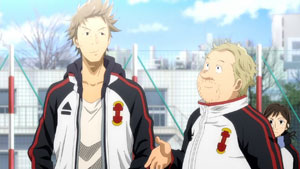
Dulalala!! ep 15

Tonight was all about shocking character designs.
I had no idea Shiki was this fucking bad ass:

And Kuzuhara without his helmet is virtually unrecognizable.

Sunday, April 18, 2010

Speaking of Nishimura

Mutant Girls Squad! Nishimura, Iguchi, and Tak Sakaguchi! I am enthused.

And a couple days later the trailer goes live. Hmm, looks like we're scaling back to "mere" Machine Girl levels of looniness this time.

It's not often that a movie peaks during the opening credits


Congratulations, you've just seen the conceptual high point of Geisha Assassin, originally and much more misleadingly titled Geisha vs Ninja; there's only one real fight with ninja and the geisha aspect is peripheral at best.

This movie only barely has a story-- it's your standard "loner bent on vengeance" plotline, brutally shorn of almost everything you'd consider plot or characters. Almost every minute is the heroine either kicking someone's ass or silently walking to the next place asskicking shall commence. While I appreciate this progressive-minded refusal to waste time on a half-baked plot, the parts of the movie they did film aren't all that great. The travel scenes are tedious, and the fights just aren't good or outrageous enough to carry the entire film. The unarmed fighting is actually much more interesting than the swordplay-- the choreography isn't exactly improved, but they're a lot more visceral, just people brutally whaling on each other until the other guy stays down. We also get to see the rare irony of someone throwing a smoke bomb to escape FROM ninja.
I mainly watched this because director Go Ohara's next film is a collaboration with the always crowd-pleasing Yoshihiro Nishimura. Hopefully that'll be a bit more memorable.

Saturday, April 17, 2010

House of Five Leaves

This season was always going to revolve around the expanded Noitamina slot, and now the first one has finally aired.
It's based on a manga with a very distinctive art style, but they've done a very good job of capturing it and making it work for the show.

I wasn't sure about the first few minutes, which have a few pointlessly cryptic moments; and I've no idea what the connection between the kid with the leaf shaped burn scars has to do with the latter half of the episode, but the kid was interesting, and the timid samurai and laid-back yakuza were both very compelling.
Looking forward to the rest of the season, which is even streaming and shit.

Saturday, April 10, 2010

Dulalala!! x7

Naturally, Narita can't just do a short story collection. He's got to pull a Kadono, and have all the stories taking place at the same time. I wound up being pretty glad I read this right after the anime helpfully reminded me who some of the characters were; he clearly wanted to give some people who haven't played an active role in a while something to do.
On that note, the first story starts off with Namie and Mika having an epic bitch off; this eventually involves Namie dousing Mika with an immobilizing drug and attempting to pour acid on her face, while Mika cheerily reveals that she's got the entire cast's apartments bugged and their computers hacked and knows everything going on everywhere. Seiji eventually steps in and settles things as only he can.
Second story was probably my favorite, since it was cheerily out of Narita's comfort zone again; focusing on Akabayashi, one of the yakuza characters introduced in the last volume. He's such a monumental bad ass that he gets stabbed in the eye by Saika, rips his own eyeball out to stop the blade from infecting him, and falls in love with Anri's mom, who was wielding the sword at the time. All of which is a flashback woven through the story of how he uses his own Dollars membership to manipulate a bunch of low level drug dealing thugs into taking out a yakuza group that's trying to kill him.
Third story is probably the most typically Narita; as the rumors about Shizuo's activities in the last few volumes spiral dramatically out of control, a group of his victims somehow becomes convinced that Shizuo has a wife and kid, and tries to kidnap them...only to get the shit kicked out of them when the wife turns out to be the Russian assassin (now working with Toma and Shizuo) Izaya's crazy ass sisters, and yakuza kid Akane, who is still carrying around a stungun.
There's also a brief romantic interlude with Celty and Shinra, constantly interrupted by phone calls from characters in all the other stories, and a framing sequence in which Izaya, in the hospital, is visited by one of the suicidal girls he was toying with in the first volume (a bit they wound up not putting in the anime, since he drugged her and put her in a suitcase just to fuck with her head.)
And volume eight's out in June. And a new Baccano came out yesterday. It never ends!

Friday, April 9, 2010

Ong Bak sequels

Ong Bak 2 is one of the most bafflingly bad films I have ever seen. I am the last person on earth to hate a kung fu film if it manages to have a sufficient quantity of great fight scenes, but Ong Bak 2 was just so fundamentally misconceived that it managed to undermine it's own action. Between having Tony Jaa's character played by a child actor for LITERALLY half the movie, and the Tinkerbell ending...
I should probably not be looking forward to the sequel.
But here's the trailer, and it looks like it at least knows how stupid it is; since they're clearly never letting Tony Jaa direct again, perhaps it won't be paced like mud trickling down the back of an elephant's corpse.

Thursday, April 8, 2010

Dulalala 13

New opening song is thoroughly vile; still has name cards in, but feels way more conventional, almost completely dropping the Guy Ritchie feel.
New ending song is also crap, but not as bad as the last one.
I love how Kuzuhara is just the dude from Wild 7.


Also, as an unrelated warning, apparently Senkou no Night Raid is the critical darling this season, but I can only assume by the same people that thought Noir was riveting and stylish. First episode managed to make superpowered noir spies boring, which should not legally be possible. So far, Anime no Chikara is doing a good job showing what is wrong with anime today. Sadly.

Wednesday, April 7, 2010

Arakawa Under the Bridge

I've heard a lot of good things about Saint Young Men, a gag manga involving Jesus and the Buddha on vacation. I'd heard absolutely nothing about the author's other ongoing series, but somehow that gets the anime adaption.
Wasn't sold early on; the main character's shtick is a bit annoying, and the crazy girl's shtick is one I always enjoy, but not terribly original.
Then the kappa showed up.

The kappa is pretty much all awesome, every second he's in the show.

Sunday, April 4, 2010

Giant Killing 01

I'm not gonna say there's anything here we haven't seen before. This is very much a classic Hoosiers style coach-centric sports story. Struggling team, new coach chosen, his selection controversial, his methods more so, eventually succeeds.

But it does that story really well. A nice, matter-of-fact, low key presentation that allows them to actually earn the payoffs. Punk rock opening and ending themes that I can pretty much already guarantee will be the best of the season. Actual native-English speakers for the opening bits in West Ham.
Very promising start.

Saturday, April 3, 2010

Rainbow 01

Initially on my list of promising Spring shows -- on the grounds that it was Madhouse adapting a seinen manga -- this fell off the moment they announced the director. Same guy who turned the awesomely insane Nougami Neuro into a limp pile of unwatchable dullness.

A prison melodrama about bromantic bonds under cartoonishly oppressive guards, Rainbow mostly just embarrasses itself. I can see how all of this overwrought posturing could be pretty awesome in the hands of a capable director, but it just seems confused and inept here. He can't even commit to the tone heartily enough to make it hilarious.

Thursday, April 1, 2010

Japan still has it


What the fuck IS this!? Looks like the best cinematic folly since Southland Tales.

Thursday, March 25, 2010

Mayumi Kojima's Blue Rondo


Mayumi Kojima's newest album, Blue Rondo, came out on 02/03, and I was finally able to try it out a couple of days ago. Now, having listened through it several times, I've come away slightly disappointed with how it turned out. All in all, I find Blue Rondo to be the weakest album in her discography so far.

Despite my harsh rhetoric, I didn't think it was horrible. To its credit, I was decently entertained, and never really bored. In fact, it's probably one of the stronger efforts I've heard out of the tens of albums I've listened this week while going through the backlog of music I've accumulated over the past quarter at college. Indeed, Mayumi's distinct voice is still here in all of its sensual, off-note, volatile glory, and there's more of that distinctive, jazz-guitar retro sound that she's loyally stuck with throughout her career. For those of you who have listened to Mayumi Kojima before, Rondo offers no departures into unfamiliar territory in terms of instrumentation. I can't comment on lyrical content because I can't understand Japanese I would have liked to hear more stylistic experimentation and exploration a la Ai no Poltergeist, but with her sound distinct as is, more of the same is most certainly pleasantly welcome. My main qualm is that this album just lacks the frenetic, wild, unpredictable energy seen in her previous outings. There's less of that visceral screeching, hissing, random vocal noises/alterations that I've come to love. Her belting seemed to be more measured and delivered with less reckless, reverberating abandon. The singles heading Rondo, "Arabesque" and "Merrygoround" are apt summaries for the rest of the album. They still get loud, there's a lazier, relaxed delivery; the crescendos are more predictable, and lack the untamed, brash edge we've seen in her previous works.

I admit that I'm just probably being a bit more of a harsh judge than I should be, since she happens to be one of my favorite artists, and the couple of delays pushing back Blue Rondo's release date hyped up my anticipation. If you've got some extra bank, you could do many worse things with your bling than importing this thing from CDJapan. Of course, if you've never listened to Mayumi Kojima before, I implore you to check out some other things in her discography first, Ai no Poltergeist and Me and My Monkey on the Moon at the forefront, before giving Blue Rondo a try.

Wednesday, March 24, 2010

Summer Wars


Instead of a clever attempt at a plot summary, I'll defer to ANN's:

“When timid eleventh-grader and math genius Kenji Koiso is asked by older student and secret crush Natsuki to come with her to her family’s Nagano home for a summer job, he agrees without hesitation. Natsuki’s family, the Jinnouchi clan, dates back to the Muromachi era, and they’ve all come together to celebrate the 90th birthday of the spunky matriarch of the family, Sakae. That’s when Kenji discovers his “summer job” is to pretend to be Natsuki’s fiancé and dance with her at the birthday celebration. As Kenji attempts to keep up with Natsuki’s act around her family, he receives a strange math problem on his cell phone which, being a math genius, he can’t resist solving. As it turns out, the solution to the mysterious equation causes a hijacking of the social networking site through which most of the world's social and business traffic flows.”

The subplots of the fiancé charade and Sakae's birthday aside, anyone familiar with the second of Mamoru Hosoda's two Digimon short films, Our War Game, will notice more than a passing resemblance to Summer Wars; this is compounded further by the look and developments (especially the climax nearly replicating the big twist and comeback!) of the two movies. Sadly, this does result in somewhat derivative moments -- even though in Summer Wars they may better those in Our War Game -- and perhaps more crucially, misses the urgency of the Digimon film. The plot is more than enough for the concise forty minutes of Our War Game, but lacks the intricacies needed to be fully satisfying when it's extended to over one hundred.

Then again, I thought Paprika was one of Satoshi Kon's lesser works, before on a second re-watch came to feel that it's his best film. Who knows how I'll see my current misgivings of Summer Wars later on?

Regardless, that's where the negatives primarily end, as it's the characters and ideas that hook themselves in your mind. While I empathize far more with Makoto (The Girl Who Leapt Through Time), Kenji's position as an awkward but principled nerd is shown quite honestly; his latent proactive attitude is the result of his own personality and talents, rather than arbitrary plot mechanics. Satsuki, while not as well-defined as Makoto, actually behaves like a real teenage girl, carefully nuanced (considerate, selfish and brave are just a few adjectives that can be applied) and developed over the course of the story. Her family is even better, with the grandmother, Sakae, being on the short list of nominees for Best Character of All-Time in animated film. She's the very embodiment of charisma, order and understanding, and also represents the film's key themes (the importance of connections, comprehending the extent of one's abilities and acting on them, and the meshing of the traditional and contemporary) in vital ways: her two important conversations with Kenji about his relationship with Natsuki; the order and invigoration she instills in the seemingly countless important workers and public officials across Japan as they deal with the Oz Crisis, never mind her family; and her mindful awareness of the family's history (both of centuries past and the present generations) and how it should be acknowledged in the future (her relationship with Wabisuke is most representative of this, with the information doled out at the most appropriate times). The rest of the family is admirably diverse and free of stereotypes, most of them well-defined based on just a few lines of dialogue, their posture, attentiveness (or lack thereof) to the situation at hand, et cetera. They're portrayed so authentically that my mind started linking all sorts of associations to my own friends and family (both the good and the bad!). Some are attuned to modern technology, others less so or not at all; in fact, the one most involved is Kazuma, a reclusive thirteen-year-old male that provides the most immediate help to Kenji, and who has his own growing pains to deal with (before and during the movie). It's the entire cast’s personal tics that engages the viewer for the first hour, and also stir the viewers through the action-oriented second half.

Oh, yeah, and there's the visuals. As with the story, Hosoda borrows and refines many of the visual ideas from Our War Game, but with greater, more consistent success. Even though they never reach the sheer plain of pleasure of the sixth One Piece movie, Hosoda... well, screencaps do a far better job than words (no actual spoilers):


Very different than the subdued tones of The Girl Who Leapt Through Time, but very vibrant, well-composed work that gives a good sense of weight and motion. Wonderful stuff.

What's the most endearing aspect of the film, though, is one that should receive plenty of thought by viewers after the credits end. In fiction, the negative side effects of technological progress (environmental degradation, alienation amongst a sea of people, deepening issues of classism) are almost always given without much, if any reflection of the positives. Summer Wars adds this much-needed perspective where this greater ease of communication allows us an astounding amount of information in mere moments, the ability to connect with friends and family that we haven't seen or spoken to in years, and even save lives. The potential for cooperation and deep, transcultural relationships is there -- it's on us to reach it. It's an optimistic point that we need reminding of more often.


Tuesday, March 23, 2010

Boogiepop Darkly: The Scat Singing Cat

When a Towa agent -- the awesomely named Thelonious Monkey -- goes missing after a fight with a mysterious MPLS known only as Scatterbrain, Reset dispatches the infamous "strongest" -- Fortissimo.
Fortissimo is a bit like the Daleks in Doctor Who. He's inherently awesome, and cheapened by overuse. I know he isn't in every Boogiepop novel, but he's been in far too many of them, and been far too ineffective in most of them, so I was a bit disappointed to see him playing a major role this time around. But I'm guessing Kadono wanted to revamp the character a bit, because I honestly don't think he's been this fucking bad ass since his first fucking appearance. Walking on water, evaporating said water with a flick of the mind, ignoring crowds of zombies attacking from all sides as they bounce off him, making his own heart explode and reform so he can free himself from a mind-control spell with a bit of temporary death -- he's single-handedly Jojoing the shit out of this volume, and it was awesome to behold. I hope Kadono has the sense to keep him out of the spotlight so the next time he shows up his very entrance provides a thrill.
This is possibly the closest to outright horror the series has been in years. The section where Fortissimo reads Thelonious Monkey's cryptic journal, encountering puzzling references to a cat set randomly between accounts of people she knows not remembering her, and her not remembering people who clearly know her, is some genuinely chilling stuff.
The other story cross cut with Fortissimo's investigation involves the local junior high's photography club searching odd corners of the town in the hopes of finding evidence that Boogiepop exists. These four are archetypal Kadono characters, all presented as stock types before their interactions serve to knock each other off balance, their reactions never quite what we expect, so that they gradually take on a life of their own.
The structure here is classic Jojo's Bizarre Adventure -- a mysterious power is at work, and the bulk of the book is spent figuring out what it is and how it works, while being more than a bit afraid of it. For once Boogiepop is forced to play a fairly active role, even if that largely just means the climax of the book has more than it's fair share of cryptic riddle-speech. For better or for worse, Kadono is a man who never strays very far from his own set of foibles. But The Scat Singing Cat is definitely on his better side.

Monday, March 22, 2010

GoGo Monster


Man. After just one reading, I know I'm unable to deliver any sort of proper review for this. But what the hell.

The story follows Yuki Tachibana, a very internalized, eccentric third grader, and his growing friendship with Makoto Suzuki, one of the few human characters in the story that does not ostracize Yuki and attempts to gain a kind of understanding with him. The two other key characters are Ganz, an elderly caretaker that recognizes Yuki's position -- where, unlike the others, he is not a skeptic of The Other Side that the boy describes -- and IQ, an acute fifth grader with a box over his head, allowing one peephole to see the world outside of himself. Yuki contends at different points in the book with various choices: whether the monsters he sees are real or hallucinatory, and if real, whether he can hold onto communicating with Them, a group of good monsters, and also protect himself from The Others, a group of destructive ones. These and others threads, such as IQ's search for a white rabbit, all flow into each other in the otherworldly 120 page climax.

Going in, I wasn't sure whether this would be more akin to Taiyo Matsumoto's long-form works (Tekkon Kinkreet, Ping Pong) or his more bizarre short stories and opaque narratives (Brothers of Japan, No. 5). Despite the wild third act, it's firmly grouped with the former, most directly invoking Tekkon Kinkreet: Yuki reesembles White; Makoto, Black; Ganz, the grandfather character; the troubling awareness of two different worlds that children experience as they grow older, torn between that of childhood of adulthood; the importance of human connections; etc. If these sound like crude simplifications, they are; it's also important that Matsumoto inverts these ideas, where here the anchor is Makoto, and it is Yuki who directly faces the surrealistic descent into himself and The Other Side. Even then my word choice isn't entirely accurate, either, for it's ascending through the school to a nonexistent floor that Yuki reaches The Other Side. This kind of duality is reflected everywhere in the narrative, whether in the repetitions (why Yuki likes the school office in the summer and winter) or in IQ' ambiguous relationship with Yuki and his almost metafictional actions and words in the narrative itself.

Beyond all that, though, is an emotional narrative for the first three seasons (and much of the beginning of winter) of the school year, with elliptical storytelling that becomes slightly grounded with the inclusions of dates. This already shows a stark difference in approach that Matsumoto takes from most manga-ka out there; after all, the story itself could be told in one-quarter or even one-tenth of the total pages (about 460, technically), but the sense of time and progression, as well as reflection (a lot of elementary school memories came back as I read this) is far too important. Compared to the final product here, a shortened version would just dull the impact.

It's pretty much redundant to say that Matsumoto's art is amazing, but he really outdoes himself here: it has the same refinement of Ping Pong, and the more ambitious scenes (IQ "dissolving" and his photorealistic eye; Makoto's first daydream and his entrance onto the many rooms of the fifth floor) better the best portions of Tekkon Kinkreet. The dozen or so darkened pages in the climax don't even bother me, as the eyes, faces and monstrous shapes are defined just enough to give detail, while also anticipating the feeling of liberation when we arrive at the wide open finish.

I'm not sure where I'd rank GoGo Monster against Matsumoto's masterpieces (Hanaotoko and the aforementioned 90s works), but that seems irrelevant; it's simply a damn good book that's required reading for anyone interested in genuinely unique storytelling. I know I'll be reading it again and again.

Shaolin

Looks pleasingly grim.

Thursday, March 18, 2010

Dulalala!! 11

So basically any other show in the world would be thrilled to have a scene as insanely great as either "everyone is in the Dollars" or "Celty rides down a fucking building" in their final episode, and Dulalala!! has both in one episode and ends on a cliffhanger. First book finale next week.
Also:

Isaac and Milia are in the Dollars!? The world does not contain enough exclamation points.

Monday, March 15, 2010

Hariyama-san, Center of the World 3

Wandering in the bamboo forest one day, a boy runs into a girl in a make-shift cloth bikini fighting a panda that seems to dodge every one of her attacks with the greatest of ease. Mortified, she attacks the boy.
Fortunately, he is a ninja.
Welcomed by his ninja parents, the girl reluctantly admits that she is an alien lifeform grown inside a stalk of bamboo; intended to spring forth full grown and capture the hearts of the planet (for strictly information gathering purposes) she has instead popped out aged twelve on account of the ninja panda attempting to eat the bamboo she was growing in.
While she quickly settles into a role as a star performer in the ninja clan's ninja village amusement park, they do run into some trouble with the local men in black, a regular thorn in their side since the head ninja was kidnapped by aliens in the color pages to the first volume in Narita Ryohgo's increasingly batshit short story collection series.
The second story in here takes Narita well outside his comfort zone, pleasingly -- the story of a man who only wants to pilot a giant robot, and thus becomes a robotics engineer for the express purpose of building a robot for himself to pilot. Problem is, just as his life's work is about to be completed, the company is bought out, and the new president wants to replace him as the test pilot with a fourteen year old child actor. (Because: Eva. Not named, but Narita says, "I don't need to, do I?") Eventually the man's opinion changes when the child actor sneaks into the factory to sneak a look at it, and he finds the boy standing in front of the robot sobbing openly at how fucking amazing it is. (The boy even admits to acting cool about the idea on TV because that's what a robot pilot would do.) Also features Hariyama's high school aged daughter for the first time...in a small supporting role, of course.
The third story is another in his urban legend series -- this time focused on the men in black. A woman wakes up in a park dressed in a black suit. She has no memories, but slowly begins to piece things together...and realizes that she was part of a group of con artists posing as men in black to scam money of the bizarre shit that happens in town, but that they wound up falling prey to an actual group of aliens...that all wear black.
While there is no big cross over story this time, he does toss in a few page long epilogue which reveals that the ninja kid is friends with the robot pilot and that the alien kid from the third story is friends with the Hariyama boy.